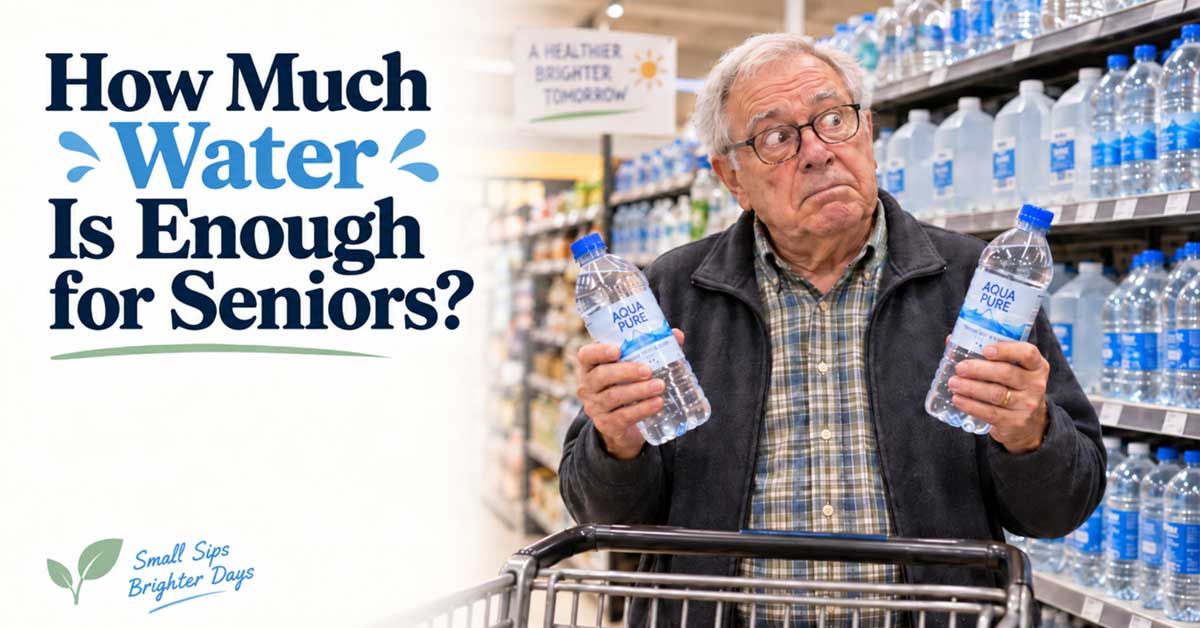
Eight glasses of water a day is familiar advice. For older adults, it is also surprisingly close to one major professional recommendation, although the science is more nuanced than a fixed number of glasses suggests.
The European Society for Clinical Nutrition and Metabolism (ESPEN) recommends that older women generally be offered at least 1.6 liters of drinks per day, while older men should be offered at least 2.0 liters, unless a medical condition requires a different approach.[1]
That works out to roughly seven 8-ounce glasses for women and eight and a half for men.
ESPEN arrives at those numbers partly from broader European guidance recommending about 2.0 liters of total water per day for women and 2.5 liters for men. Importantly, total water includes both beverages *and* water contained in food.[1]
So, how much is enough? Current science gives us several useful clues:
Food counts. ESPEN estimates that beverages typically provide about 70% to 80% of fluid intake, with the remainder coming from food.[1] In one study of independently living adults ages 60 to 83, food supplied nearly half of total water intake.[2]
Needs differ from person to person. A large 2022 study involving more than 5,600 people found that water turnover varies with age, body size, physical activity, temperature, humidity and other factors.[3] There is no single physiological water requirement that fits everyone.
Water needs generally decline with age. That same research found that water turnover tends to decrease later in life.[3] Older adults still face a greater risk of dehydration because thirst and other mechanisms that protect fluid balance can become less reliable.
Conditions change the calculation. Hot weather, physical activity, fever, vomiting and diarrhea can increase fluid needs. Some people with heart or kidney disease may instead need to limit fluids under medical guidance.[1]
So Is Eight Glasses a Good Rule?
For many older adults, it is a reasonable rule of thumb.
It should not necessarily be treated as eight glasses of plain water that must be consumed regardless of everything else a person eats and drinks. Green tea, milk, other beverages and water-rich foods all contribute to hydration.
The most useful goal is regular fluid intake throughout the day, with extra attention during heat, illness and other situations that increase water loss.
Older adults who have been given specific fluid instructions by a physician should follow those instructions. For everyone else, the familiar eight-glass rule may be a useful starting point, even if the science behind hydration is more individualized than the slogan suggests.
SOURCES
Volkert D, Beck AM, Cederholm T, et al. ESPEN practical guideline: Clinical nutrition and hydration in geriatrics. Clin Nutr. 2022;41(4):958-989. doi:10.1016/j.clnu.2022.01.024.
Gonçalves A, Silva AM, Carvalho LM, et al. Urinary hydration biomarkers and water sources in free-living elderly. Nutr Hosp. 2016.
Yamada Y, Zhang X, Henderson MET, et al. Variation in human water turnover associated with environmental and lifestyle factors. Science. 2022;378(6622):909-915. doi:10.1126/science.abm8668.